
Many people need reading glasses for one reason and distance glasses for another, then spend the day switching back and forth between them. There’s a simpler option. Progressive lenses hold more than one prescription in a single lens, so you can see across the room, at arm’s length, and up close through one pair of glasses.
The power changes gradually from the top of the lens toward the bottom, and that gradual change in lens power is what keeps the visible line of a bifocal off your face.
How Progressive Lenses Differ From Bifocals
Bifocals carry 2 prescriptions divided by a line, and your view can jump as your eyes cross it. Progressives blend the powers into each other instead. You also get usable vision at middle distances, which matters now that so much of daily life sits about an arm’s length away.
The 3 Vision Zones in Progressive Lenses
Each part of the lens handles a different distance, and you reach it by moving your eyes a little:
- Look through the top for faraway objects, like the road ahead or a hockey game from the stands
- Keep your gaze level for arm’s-length tasks such as a computer screen or your car’s dashboard
- Drop your eyes toward the bottom for close work like a book, a recipe, or your phone
A narrow channel connects those zones, and the power builds as it runs down the lens. The outer corners sit outside that channel, so they can look out of focus when you glance sideways. Aim your nose at what you want to see, and you’ll look through the clear part of the lens.
Who Might Benefit From Progressive Lenses
Around age 40, the lens inside the eye becomes less flexible and close focus gets harder. Presbyopia builds slowly, and a few signs tend to show up first:
- Small print you can only read at arm’s length
- Tired eyes after a stretch of close work
- Headaches later in the day
- Blurriness when you look up from your phone to something across the room
Progressives can suit you if you’d rather not carry 2 pairs of glasses everywhere. Some nearsighted children also wear a form of progressive lens as part of a myopia management plan, which your optometrist can walk you through at a children’s eye exam.

What Goes Into Fitting Progressive Lenses
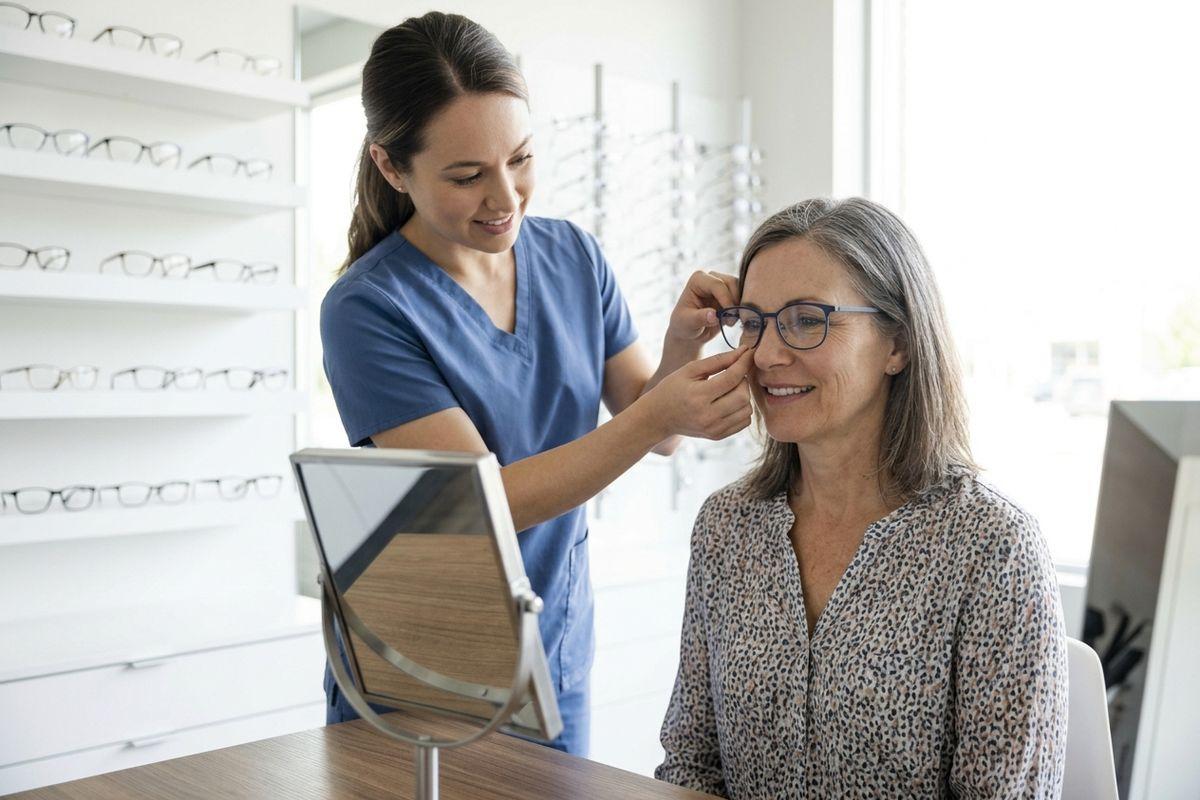
Measurements may matter more here than they do with a single-vision lens. Your optometrist and optician record where your pupils sit inside the frame you’ve chosen, so each zone lands where your eyes actually look.
Progressive lenses could affect which frames you can wear. A very shallow frame leaves little room for the reading area, so deeper styles are often easier to work with. Smaller frames can still work well when the lens design suits them.
Lens designs vary as much as frames do. Digitally surfaced progressives are cut with more precision than older moulded designs and can widen the usable channel, which some wearers notice right away. Your prescription and how you spend your day both feed into that choice, so bring up your work setup and your hobbies while you’re picking lenses.
How to Adjust to Progressive Lenses
New lenses can take a bit of practice before they feel natural. A few habits can smooth out the first couple of weeks:
- Wear them from morning to evening rather than switching back to your old pair
- Point your nose toward whatever you want to see clearly
- Turn your head to scan side to side instead of moving only your eyes
- Hold your phone or book slightly lower than you’re used to
- Take stairs slowly at first, since the reading zone can make steps look closer than they are
Some blurriness near the edges is normal early on. Most people stop noticing it within 2 weeks or so. If something still feels off after that, bring the glasses back in and we can check the fit and the measurements.
Progressive Lenses Compared with 2 Pairs of Glasses
One pair that covers everything means less to carry and nothing to swap partway through a meal. That convenience appeals to many people, and it’s why many wearers stick with progressives once they’ve adapted.
Two pairs still suit some routines and can cost less up front. Think about where you need clear vision most, and how often your eyes move between distances during a normal day.
If you spend hours at a screen, ask about computer lenses built to widen the intermediate zone. They can ease the digital eye strain that builds over a long workday, along with the neck and shoulder ache that comes from tilting your head to find focus.
Find the Progressive Lenses That Fit How You Live
Progressive lenses can simplify a day that keeps moving between close-up reading and whatever is happening across the room. The right pair starts with a current prescription and careful measurements, so book an eye exam and bring along any frames you already have your eye on.
Amherstview Eyecare fits progressive lenses and provides eye exams for families across the Kingston area. Book your appointment and let’s find the lenses that match how you live!